
- Crane rail systems are a vital part of paper mill operations, supporting overhead cranes that move heavy equipment, paper rolls, and production components while helping reduce downtime and equipment wear.
- Overhead cranes rely on rails, clips, pads, anchor bolts, joint bars, and fastening systems working together to maintain stable crane travel and distribute heavy loads.
- High humidity and corrosive operating environments accelerate wear on crane rail components, making routine inspection and maintenance important.
- Selecting compatible crane rails and fastening components that match your crane and operating conditions helps improve service life.
- Central Rail Supply provides crane rails, fastening systems, and supporting hardware to help paper mills source compatible products for new installations, maintenance projects, and rail replacements.
These facilities use overhead cranes to move paper rolls and heavy equipment, each one depending on a solid, well-manufactured crane rail system. In this guide, we’ll go over how crane rail systems are used in paper mills, the conditions that affect their service life, and what you should consider when planning maintenance, repairs, or rail replacement.
Crane Rail System Components – an Overview
- Crane Rails: Crane rails carry the weight of the crane and its load while providing the running surface for the wheels. Rail condition affects wheel wear, load distribution, travel, and the service life of the equipment.
- Rail Clips: Rail clips secure the rails to the supporting beam while allowing controlled movement caused by loading and temperature changes. If clips loosen or wear, the rails can move from their intended position and affect crane travel.
- Rail Pads: Rail pads separate the rails from the supporting steel and help reduce vibration as the crane moves along the runway. They also distribute loading across the beam and reduce direct contact between steel components.
- Anchor Bolts and Fasteners: Anchor bolts and fastening systems hold the rail assembly in place under repeated loading. If bolts loosen or fasteners wear, the entire assembly can become unstable and place greater stress on nearby components.
- Joint Bars: Joint bars connect adjoining rail sections and create a continuous running surface for crane wheels. Well-maintained joints reduce impact as the crane passes from one section to the next and help limit wear on wheels and rails.
Why Paper Mills in Atlantic Canada Depend on Overhead Crane Systems
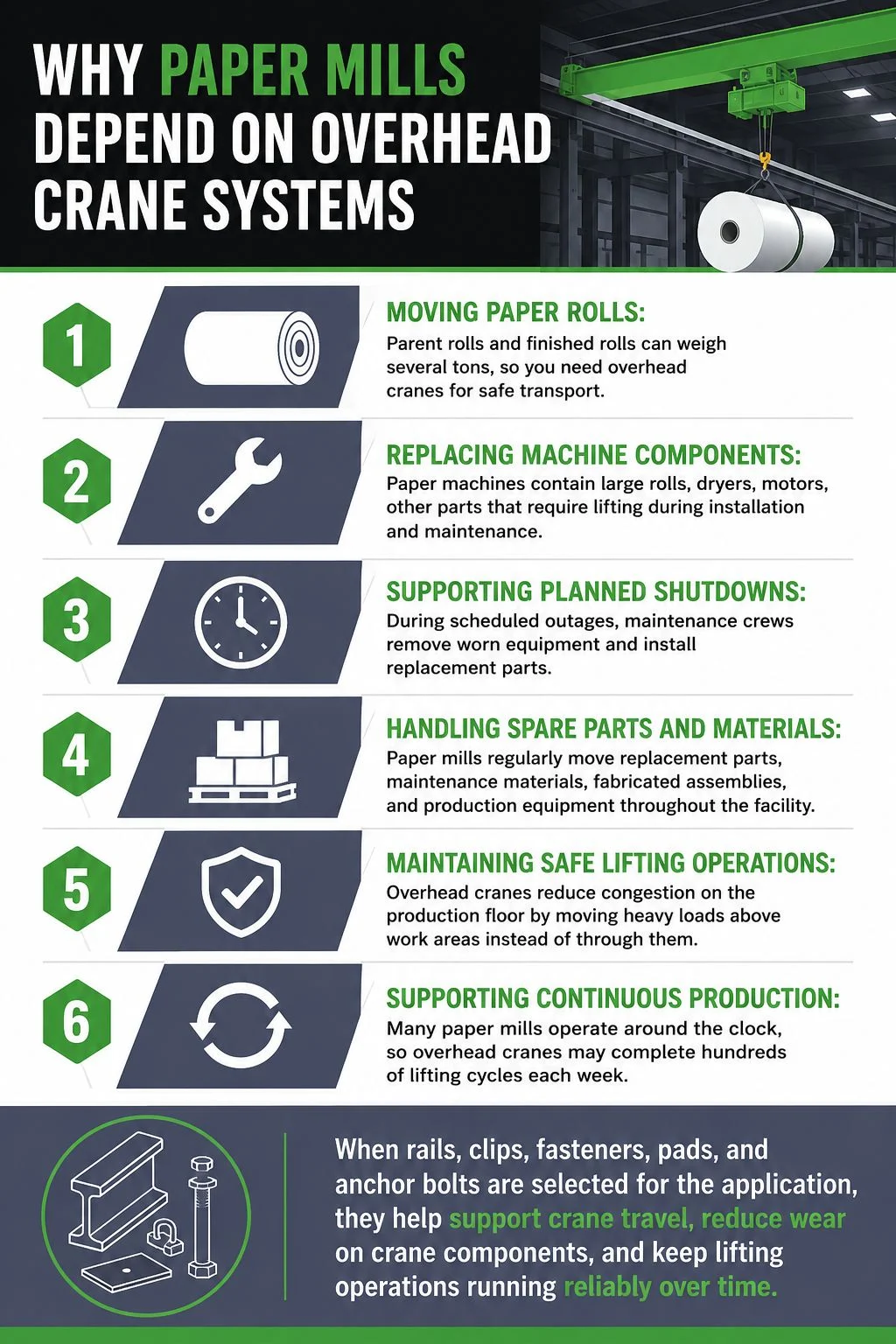
- Moving Paper Rolls: Parent rolls and finished rolls can weigh several tons, so overhead cranes are used to move them between production, storage, converting, and shipping areas. For Atlantic Canadian mills handling high production volumes, dependable lifting equipment helps keep materials moving without relying solely on floor-level transport.
- Replacing Machine Components: Paper machines contain large rolls, dryers, motors, pumps, and other components that may require lifting during installation, inspection, or replacement. Overhead cranes give maintenance teams access to equipment that would be difficult to handle with mobile lifting equipment inside an operating mill.
- Supporting Planned Shutdowns: Mills commonly schedule shutdowns to inspect equipment, complete repairs, and replace worn components within a limited maintenance window. Stable crane travel can help crews move machinery and replacement parts where they’re needed while keeping lifting work coordinated with other shutdown activities.
- Maintaining Safe Lifting Operations: Overhead cranes move heavy loads above production areas instead of routing them entirely through busy floor space. This is particularly useful in large mills where production equipment, stored materials, and maintenance activity may compete for available space.
- Supporting Continuous Production: Many pulp and paper operations run extended or continuous production schedules. Overhead cranes support repeated lifting cycles for production, maintenance, and material handling, making the condition of the crane runway and rail system an important consideration for facilities trying to limit unplanned interruptions.
Challenges Facing Crane Rail Systems in Paper Mills
Certain conditions inherent to paper mills in New Brunswick and the rest of Atlantic Canada can contribute to wear over time. If they aren’t addressed, they can shorten the service life of rails, fasteners, and other supporting components.
- High Humidity: Steam, washdown activities, and damp operating conditions expose crane rail components to constant moisture. In Atlantic Canadian facilities, regional humidity and coastal conditions may add to that exposure, particularly where equipment is located near exterior openings or less-controlled areas.
- Coastal Exposure: Mills located near the Atlantic coast or other saltwater environments may face corrosion risks from salt-laden air. Salt can contribute to the deterioration of unprotected steel surfaces and fastening components, making coating condition and corrosion monitoring especially important.
- Corrosive Chemicals: Pulp and paper production may involve caustic soda, bleaching agents, and other processing chemicals that can affect nearby steel components. Chemical residue, vapour, or accidental exposure can accelerate corrosion on rails, and supporting hardware, especially in areas where moisture is also present.
- Seasonal Temperature Changes: Atlantic Canada experiences seasonal temperature swings, and industrial buildings respond by expanding and contracting. These movements can affect the supporting steel and gradually influence rail position, particularly along long crane runways.
Strong and well-matched crane rail components can help paper mills manage these operating challenges and reduce premature wear. Central Rail Supply provides expertly-engineered crane rail products and fastening components for industrial applications across Atlantic Canada, helping mills source compatible parts for maintenance, replacement, and runway upgrades.
Choosing the Right Crane Rail Components for Your Mill
Selecting crane rail products isn’t limited to choosing the rail itself. Rail profile, fastening hardware, wheel loads, operating conditions, and the condition of the existing installation can all affect what products are suitable for a repair or replacement project. Central Rail Supply has supplied industrial rail products in Canada since 1987, giving us decades of experience helping facilities identify crane rail and related components for demanding industrial applications.
- Supplying Crane Rails: We provide crane rails for overhead crane applications, with multiple rail profiles available for different wheel loads, duty cycles, and operating conditions. This gives mill operators options when planning new installations, upgrades, or replacements.
- Providing Complete Fastening Systems: Central Rail Supply supplies the critical hardware used in crane rail installations. Sourcing these components alongside the rail can make procurement easier and help avoid delays caused by missing or incompatible hardware.
- Supporting Replacement Projects: Replacing worn crane rail components doesn’t always mean replacing the entire installation. Depending on the condition of the system, replacement rails or fastening hardware may be incorporated while serviceable components remain in place.
- Helping Match Existing Rail Profiles: For crane systems that have been operating for decades, identifying the rail already installed can be difficult. Central Rail Supply can help you identify existing rail profiles and determine which hardware may suit the application. This is especially important when original drawings, specifications, or product records are incomplete or no longer available.
- Serving Heavy Industry: Central Rail Supply is based in Hamilton, Ontario, and supplies customers across Canada, including Atlantic Canada. We work with facilities in pulp and paper, manufacturing, mining, ports, steel production, warehousing, and other heavy industrial sectors.
- Sharing Product Knowledge: We can help customers compare rail profiles, fastening options, and related components based on the requirements of the existing system. That support can be especially useful when an older installation is being repaired or it includes components no longer commonly stocked
Keeping Your Paper Mill Running With Crane Rail Systems
Paper mills need a crane rail assembly that can last through years of repeated use. Selecting quality rails, fastening systems, and supporting hardware before wear becomes a larger problem can reduce downtime and extend the service life of the entire installation.
If you need help identifying an existing rail profile, planning work around a scheduled shutdown, replacing worn rail or clips, extending a crane runway, or sourcing compatible components, Central Rail Supply can help. We can assist with matching rails and related hardware to your existing system and project requirements. For more information or to place an order, please call 905.521.8477.
Sources
- Innovation, Science and Economic Development Canada. Pulp, Paper and Paperboard Mills (NAICS 3221): Canadian Industry Statistics. Accessed June 29, 2026. https://www.ised-isde.canada.ca/app/ixb/cis/businesses-entreprises/3221
- Atlantic Canada Opportunities Agency. Atlantic Canada. Accessed June 29, 2026. https://atlantic4.ca/atlantic-canada