
- Crane rail systems are essential to marine terminal operations in Atlantic Canada, supporting ship-to-shore crane movement and enabling consistent cargo throughput in demanding coastal conditions.
- Proper rail profile selection depends on wheel load, wheel diameter, and girder spacing, with heavier sections required for high-capacity cranes to reduce wear and maintain stability.
- Rail fastening systems, including clipped and bolted designs, help maintain alignment, control lateral movement, and manage impact forces under repeated loading cycles.
- Coastal environments accelerate deterioration through salt corrosion and freeze-thaw cycles, which can weaken fasteners and degrade the grout foundation beneath rails.
- Regular inspection and maintenance are critical, with alignment checks and component replacement helping prevent failures.
- Monitoring wear patterns such as head, side, and base wear allows operators to identify issues early and plan timely rail or component replacement.
At Central Rail Supply, we supply marine terminal operators across Atlantic Canada with crane rail products, track components, and accessories built for this environment. In this guide, we cover how to select, install, and maintain crane rail systems that keep your terminal running through every season.
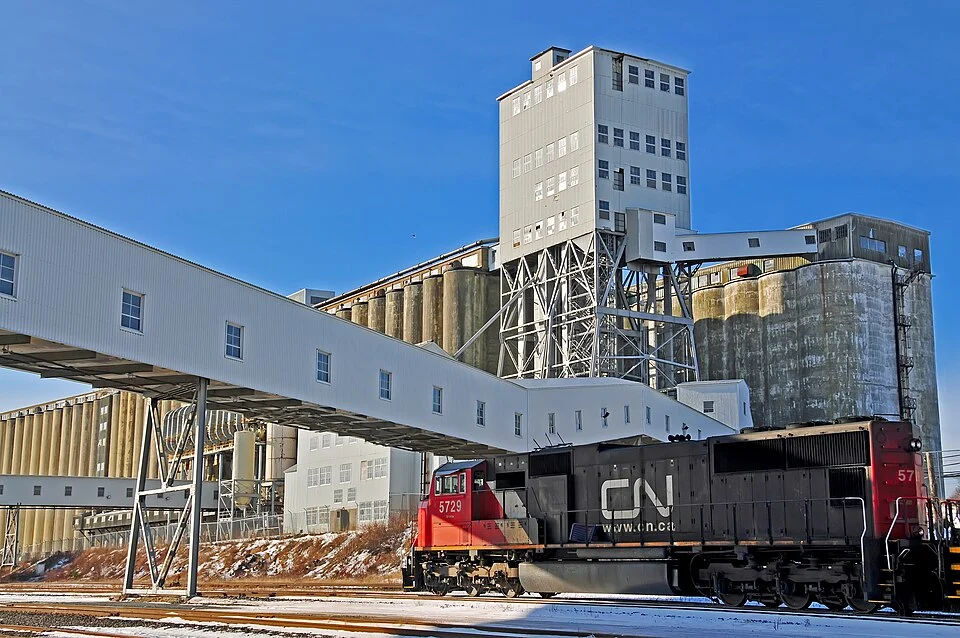
Dennis G. Jarvis, CC BY-SA 2.0 via Wikimedia Commons
Crane Rail Profiles: Choosing the Right Section for Marine Terminal Loads
Marine terminal cranes travel along rail under full load, accelerating and braking dozens of times a shift. That repeated dynamic loading is what makes profile selection so important. Choose a section that’s too light for the crane above it and you’re looking at accelerated head wear, rail rollover risk, and a shortened service life for the entire runway system.
The rail head’s width and the weight of the base determine how load moves through the system:
- A wider head spreads contact stress across a larger surface area, cutting the localized pressure that causes rolling contact fatigue.
- A heavier base keeps the rail laterally stable when wheel flange forces push hard against the head during those acceleration and braking cycles.
When sourcing components, you’ll want to follow these three guidelines:
- The wheel load specified by the crane manufacturer
- The wheel diameter
- The spacing of the runway girders underneath
We carry heavy-duty crane rail in the sections marine terminal operators need, along with fastening systems and track components to complete the runway assembly.
Rail Fastening Systems: Holding the Rail Under Marine Terminal Loads
Your crane rail system needs to be secured firmly to the runway beam. Over time, the cyclic loading typical of marine crane operations can cause the rail to:
- Shift laterally
- Wear unevenly at the clip contact points
- Transmit impact forces directly into the grout layer beneath it
The fastening system helps prevent all three of those failure modes from taking hold during port operations. Marine terminal fastening systems fall into two categories: clipped systems and bolted systems:
- Clipped systems use rail clips, either fixed or adjustable, to grip the rail base and transfer lateral loads into the runway beam.
- Bolted systems anchor the rail through the base with bolts set into the beam below.
Clipped systems have the advantage of allowing lateral adjustment during installation and re-alignment after settlement. In a coastal environment where temperature and moisture cycles can cause concrete runway beams to shift, this capability is important.
Central Rail Supply providers rail clips, anchor bolts, and the track components marine terminal operators need to complete the runway assembly. Contact our team to talk through the fastening system that suits your crane class and runway configuration.
The Atlantic Canada Environment: What Salt Air and Freeze-Thaw Cycles Do to Crane Rail Systems
The coastal environment at Atlantic Canada’s marine terminals can be challenging for crane rail systems. For example:
- Salt-laden air works into clip contact surfaces, bolt threads, and any location where dissimilar metals meet, thinning clip sections over time and reducing the clamping force that holds the rail to the beam. Pitting at the rail base concentrates stress at those corroded points during every loading cycle, accelerating wear in ways that don’t show up until a clip fails or a rail shifts under load.
- Freeze-thaw cycling attacks the grout bed from below. Water infiltrates through cracks that open during loading cycles, then expands when temperatures drop below zero. That expansion widens existing cracks, admits more water the next time temperatures rise, and progressively undermines the bearing surface.
ASME B30.2 establishes inspection intervals based on crane service conditions, with more frequent inspections for equipment operating in more severe environments. For busy marine terminals, regular inspections of crane rails, fasteners, and supporting components can help identify wear, corrosion, and movement before they lead to equipment failures.
Crane Rail Wear: Reading the Signs Before a Failure Occurs
In a marine terminal environment, the three wear modes that you’ll encounter the most are head wear, side wear, and base wear.
Head wear develops from repeated wheel contact at the same point along the rail. At a busy terminal, the rail head develops a localized depression at those stopping points. Signs of head wear to look for include:
- Visible depressions or flattening along the rail head at frequent stopping points
- Cracking at or near the worn zone on the rail head surface
- Uneven wheel contact visible during crane travel
Side wear develops when crane alignment drifts and the wheel flange bears repeatedly against the rail head face. Signs to look for include:
- Narrowing of the rail head on one side
- Bright metal scoring along the rail head face where the wheel flange contacts
- Flange wear on the crane wheels themselves, which can indicate repeated contact between the wheel flanges and the rail.
Base wear often surprises operators who inspect only the top of the rail. Signs of base wear to look for include:
- Fretting corrosion at clip contact points along the rail base
- Loss of flat bearing surface on the underside of the rail base
- Loose or displaced clips where the base has worn away the contact area
We carry the crane rail sections and fastening components you need when wear measurements tell you a replacement is due.
Keeping Your Marine Terminal Running With Premium Crane Rail Systems
The crane rail systems underneath Atlantic Canada’s ship-to-shore cranes make key port activity possible. To help terminal operators keep their runways in service, Central Rail Supply provides crane rail sections, rail clips, anchor bolts, and other track components. Based in Hamilton, Ontario, we supply these industrial rail products to customers across Canada, including Atlantic Canada. If you need help identifying an existing rail profile, planning a runway repair or replacement, or sourcing rail and fastening components, please call us at 905.521.8477.
Sources
- Dominic Magli, “Port of Halifax Hits 502,000 TEUs in Strong 2025 Performance,” Port Technology International, February 25, 2026, accessed May 5, 2026, https://www.porttechnology.org/port-of-halifax-hits-502000-teus-in-strong-2025-performance/ .
- American Society of Mechanical Engineers (ASME), “B30.2 Overhead and Gantry Cranes,” accessed May 5, 2026, https://www.asme.org/codes-standards/find-codes-standards/b30-2-overhead-gantry-cranes